

Most business leaders think of recruiters the way they think of plumbers: you call them when something breaks, they fix it, and they leave. That transactional mindset is costing companies more than they realize. The role of recruiter partnership in business growth has shifted dramatically. Today's most effective recruitment collaborations function as ongoing strategic assets, shaping workforce architecture, reducing costly turnover, and keeping talent pipelines warm before hiring surges hit. This guide breaks down how that shift works in practice, what it means for your organization, and how to build partnerships that actually move the needle.
Table of Contents
- Key takeaways
- The role of recruiter partnership in business growth
- Operational benefits of embedding recruitment partners
- Scaling fast without sacrificing talent quality
- Choosing the right recruitment partnership model
- Building partnerships that last
- My take on why this changes everything
- How Teamprovide helps you grow through better hiring
- FAQ
Key takeaways
| Point | Details |
|---|---|
| Recruiters as strategic partners | Effective recruitment partnerships go beyond filling roles to shape workforce planning and long-term growth. |
| Measurable hiring improvements | Strategic partnerships improve time-to-fill, quality-of-hire, and hiring manager bandwidth within the first quarter. |
| Early engagement wins | Engaging recruitment partners before hiring surges builds warm pipelines and prevents emergency hiring mistakes. |
| Model selection matters | Choosing the right partnership model, whether RPO, embedded, or transactional, determines how well it aligns with your growth stage. |
| Shared KPIs drive outcomes | Setting clear metrics and service-level agreements with your recruitment partner keeps both sides accountable and results-focused. |
The role of recruiter partnership in business growth
For decades, the dominant model was simple: a role opens, you call an agency, they send candidates, you hire or you don't. The agency collects a fee and disappears. That model still exists, but it produces predictably mediocre results because it treats hiring as a transaction rather than a business function.
The shift happening right now is significant. 63% of organizations are prioritizing the development of a critical talent sourcing strategy for 2026, according to a survey of 1,268 HR professionals by SHRM. That number reflects a growing recognition that talent strategy is business strategy. You cannot separate the two.
What does a genuine recruitment partnership look like? It looks like a recruiter who sits in on quarterly planning calls, understands which product lines are scaling, knows your culture well enough to reject a technically perfect candidate who would clash with your leadership team, and proactively surfaces market intelligence about where your competitors are poaching talent. SHRM's 2026 research describes this evolution as recruiters becoming "Talent Architects" who contribute to lower turnover, better hire-fit, and long-term workforce stability.
The measurable business impacts of this shift are real:
- Lower turnover rates because candidates are assessed for cultural fit, not just technical qualifications
- Faster time-to-fill because partners maintain active pipelines rather than starting from scratch each time
- Better alignment between hiring decisions and revenue or product milestones
- Reduced pressure on internal HR teams who can focus on retention and development instead of sourcing
Pro Tip: Ask any recruitment partner you're evaluating to describe a time they talked a client out of hiring a candidate. If they can't answer that question, they're a vendor, not a partner.
Operational benefits of embedding recruitment partners
The difference between a recruitment vendor and a recruitment partner shows up most clearly in the day-to-day operational details. Vendors respond to requisitions. Partners attend hiring meetings, absorb organizational context, and understand the unwritten rules that define what "good" looks like inside your company.
Embedding recruiters in hiring teams allows them to understand cultural hiring standards that go well beyond job descriptions. A job description can tell a recruiter you need a supply chain director with fifteen years of experience. It cannot tell them that your last three supply chain directors failed because they couldn't operate without large support teams, and your lean operation requires a hands-on builder mentality. An embedded partner learns that distinction over time and filters for it automatically.
Here is what that integration produces in measurable terms:
- Reduced time-to-fill. Partners who know your hiring process, your decision-makers, and your non-negotiables move faster. They don't waste three weeks submitting candidates who will never pass the culture screen.
- Higher quality-of-hire. Effective recruitment partnerships improve quality-of-hire scores alongside cost-per-hire and hiring manager satisfaction, according to research from Smart Money Match.
- Freed-up HR bandwidth. When a partner handles sourcing, screening, and pipeline management, your internal HR team can focus on onboarding, engagement, and retention programs that actually keep the people you've worked hard to hire.
- Structured RPO advantages. Recruitment Process Outsourcing arrangements take this further by giving companies access to dedicated recruiting infrastructure without building it internally. Companies transitioning to structured RPO partnerships see measurable improvements in hiring metrics within the first quarter.
Pro Tip: When evaluating a potential recruitment partner, ask to speak with three of their current clients who are in a similar growth stage to yours. The quality of those references will tell you more than any pitch deck.
Scaling fast without sacrificing talent quality
Rapid growth creates a hiring paradox. The faster you need to scale, the less time you have to be selective. The less selective you are, the more likely you are to make expensive hiring mistakes that slow you down six months later. Recruitment partnerships are specifically designed to resolve that paradox.

Consider the current market context. VC funding in Q1 2026 hit $297 billion, 2.5 times the previous quarter, according to Crunchbase data. That capital injection means hundreds of companies are simultaneously trying to hire the same senior engineers, operations leaders, and supply chain specialists. The competition for elite talent has never been more intense, and companies without established talent pipelines are at a serious disadvantage.
Recruitment partnerships address this challenge in several concrete ways:
- Pre-built pipelines. Partners who are engaged before a hiring surge maintain warm relationships with passive candidates. When you need to move, they can move immediately.
- Market intelligence. A well-connected recruitment partner knows which competitors are restructuring, which executives are quietly exploring new opportunities, and where the talent pools are deepest for your specific needs.
- Niche skill access. Recruitment partnerships deliver the highest value during VC-led scaling sprints, multi-country expansions, and niche skill hiring because of the complexity and volume involved.
- Cost efficiency under pressure. Recruitment partnerships reduce operational staffing costs while bringing specialist knowledge and market insights quickly, which matters most when you're hiring at speed.
The single most important tactical move is timing. Early engagement with recruitment partners before hiring surges builds a warm pipeline and avoids the emergency hiring risks that derail growth plans. If you wait until you have ten open roles and a board deadline, you've already lost ground.
Choosing the right recruitment partnership model
Not every partnership structure fits every organization. The model you choose should reflect your hiring volume, the complexity of your roles, your internal HR capabilities, and how tightly you want the partner integrated into your operations.
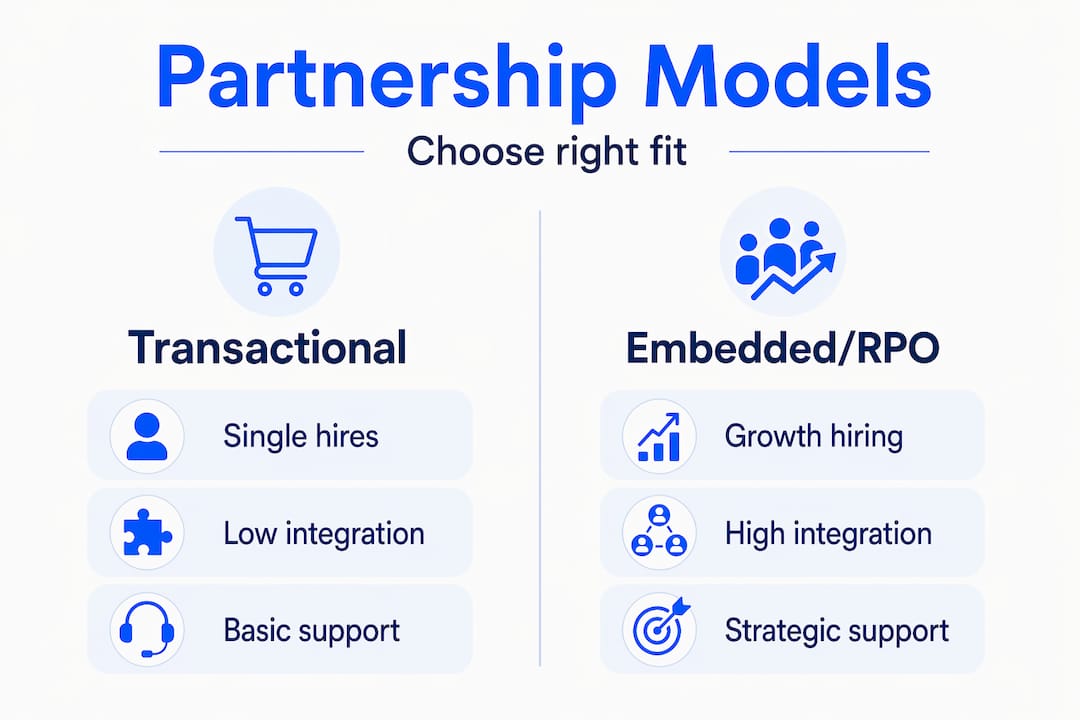
| Model | Best for | Integration level | Accountability |
|---|---|---|---|
| Transactional agency | Low-volume, one-off hires | Minimal | Placement-based |
| Embedded recruiter | Mid-size companies scaling steadily | High | Shared KPIs |
| RPO provider | High-volume or multi-location hiring | Full process ownership | SLA-driven |
| Executive search firm | Senior and specialized leadership roles | Consultative | Outcome-focused |
Transactional agencies work fine for filling a single administrative role. They fall apart when you need someone who understands your culture, your growth trajectory, and the specific leadership qualities that have driven your best hires. For that, you need a model with deeper integration.
The embedded recruiter model works particularly well for companies in the 50 to 500 employee range that are growing steadily but don't yet have the volume to justify a full RPO arrangement. The recruiter becomes a de facto member of your HR team, attending planning meetings and building institutional knowledge over time.
RPO providers make sense when hiring volume is high enough that managing the process internally would consume your entire HR department. The tradeoff is that RPO requires a longer onboarding period before the partner fully understands your culture.
Pro Tip: Whichever model you choose, build in a post-hire feedback loop. Have hiring managers rate each placement at 30, 60, and 90 days. Share that data with your recruitment partner. It's the fastest way to calibrate their understanding of what "great" looks like inside your organization.
Building partnerships that last
A recruitment partnership is not a contract you sign and forget. It requires active management, clear expectations, and a willingness to treat the relationship as a genuine collaboration rather than a vendor arrangement.
Here are the steps that separate lasting partnerships from ones that quietly fade after the first few hires:
- Audit your current recruitment process. Before bringing in a partner, map out where your hiring breaks down. Is it sourcing? Screening? Offer acceptance rates? Knowing your weak points helps you select a partner who addresses them specifically.
- Set shared KPIs from day one. Strategic recruitment integrates hiring with revenue and product milestones, and your partnership metrics should reflect that. Agree on time-to-fill targets, quality-of-hire scores, and offer acceptance rates before the first search begins.
- Communicate context, not just job descriptions. Brief your partner on business priorities, upcoming product launches, team dynamics, and leadership changes. The more context they have, the better their sourcing decisions will be.
- Review and recalibrate quarterly. Markets shift, your business priorities shift, and the talent pool shifts. A quarterly review with your recruitment partner keeps the relationship aligned with where you're actually headed.
- Treat them like an internal team member. Invite partners to relevant all-hands meetings or strategy sessions. The more they understand your business, the more they function as a strategic talent partner shaping your workforce architecture rather than just filling slots.
Pro Tip: The biggest mistake companies make is engaging a recruitment partner reactively, only when a role opens. Build the relationship during quiet periods so the partner is fully calibrated when you need to move fast.
My take on why this changes everything
I've watched companies treat recruitment as a back-office function for years, and the pattern is almost always the same. They hire reactively, they make compromises under pressure, and then they spend the next twelve months managing the consequences of those compromises. The cost is enormous, not just in direct replacement fees, but in lost productivity, team morale, and the opportunity cost of having the wrong person in a critical seat.
What I've found is that the companies who grow with the least friction are the ones who treat their recruitment partners the same way they treat their best advisors. They share information freely, they ask for honest pushback, and they invest in the relationship before they need it. When a hiring surge hits, those companies don't scramble. They execute.
The uncomfortable truth about reactive hiring is that it almost always produces candidates who are available rather than candidates who are right. A warm pipeline built through a genuine partnership gives you access to people who weren't looking until your partner called them. That's a fundamentally different talent pool.
My advice to any leader hesitant to invest in a true recruitment partnership: calculate what one wrong senior hire cost you in the last three years. Then ask whether a deeper relationship with a specialist recruiter might have changed that outcome. The answer is almost always yes.
— Frank
How Teamprovide helps you grow through better hiring
If the frameworks in this article resonate, Teamprovide was built to put them into practice. Specializing in executive recruitment across manufacturing, engineering, and supply chain sectors, Teamprovide operates as a genuine strategic partner rather than a placement service. With over 500 successful placements and a 95% client satisfaction rate, the team brings deep sector knowledge, data-driven candidate assessment, and a genuine understanding of client culture to every search. Whether you're scaling a leadership team or filling a critical niche role, Teamprovide's recruitment solutions are designed to move fast without cutting corners on fit. Explore how a tailored partnership can support your next growth phase.
FAQ
What is the role of recruiter partnership in business growth?
Recruitment partnerships contribute to business growth by improving hiring quality, reducing time-to-fill, and aligning talent acquisition with strategic business milestones. When embedded properly, recruitment partners function as workforce architects rather than transactional vendors.
How do recruitment partnerships improve hiring efficiency?
Strategic recruitment partnerships improve key hiring metrics including time-to-fill, cost-per-hire, and hiring manager satisfaction, often within the first quarter of engagement, according to research from Smart Money Match.
When should a company engage a recruitment partner?
The best time to engage a recruitment partner is before a hiring surge, not during one. Early engagement allows partners to build warm candidate pipelines and understand your culture, which prevents rushed, reactive hiring decisions.
What is the difference between RPO and an embedded recruiter?
RPO providers take full ownership of the recruitment process and work best for high-volume or multi-location hiring. Embedded recruiters integrate closely with your internal team and are better suited for steady-growth companies that need cultural depth over process scale.
How do you measure the success of a recruitment partnership?
Track time-to-fill, quality-of-hire scores, offer acceptance rates, and post-hire performance at 30, 60, and 90 days. Sharing this data with your recruitment partner is the most effective way to continuously improve candidate quality over time.