

Hiring a senior leader in manufacturing, engineering, or supply chain is one of the highest-stakes decisions your organization will make. Yet many HR executives and business leaders rush the step that determines whether the hire succeeds before it even starts: the decision to evaluate executive search firm partners rigorously. The wrong partner costs you time, money, and sometimes the candidate. The right one brings you talent you could never have reached on your own. This guide gives you a practical, no-nonsense framework to assess executive search partners, spot the red flags, and select a firm that will actually deliver.
Table of Contents
- Key takeaways
- How to evaluate executive search firm partners: the foundation
- A step-by-step process for evaluating search firm candidates
- Common pitfalls when evaluating recruitment partners
- Verifying outcomes after the engagement starts
- My take on choosing the right search partner
- How Teamprovide helps you secure specialized leadership talent
- FAQ
Key takeaways
| Point | Details |
|---|---|
| Prepare before you evaluate | Define role requirements, culture fit criteria, and search scope before approaching any firm. |
| Request a proof pack | Ask finalist firms for a 5-page document covering track record, methodology, and passive talent access. |
| Verify senior partner involvement | Confirm the partner who sells the search is the same person who executes it. |
| Boutique vs. large firm trade-offs | Boutique firms typically offer fewer off-limits conflicts and more direct partner accountability. |
| Measure outcomes, not just placements | Track 90-day and 12-month retention, leadership impact, and communication quality post-engagement. |
How to evaluate executive search firm partners: the foundation
Before you send a single RFP or take a single call, you need clarity on what you are actually searching for. This sounds obvious, but it is where most evaluation processes break down. If you cannot articulate the role, the culture, and the non-negotiable leadership qualities in concrete terms, no search firm can help you effectively.
Start with three documents: a detailed role brief, a candidate profile that goes beyond functional skills, and a clear description of your organization's culture and operating environment. In manufacturing and supply chain specifically, context matters enormously. A VP of Operations who thrives in a high-volume consumer goods environment may struggle in a precision engineering firm with long production cycles and regulatory complexity.
Once your requirements are sharp, you can begin applying criteria for search firm evaluation. The core dimensions are:
- Outcomes and track record: Can they show placements in your sector at the seniority level you need?
- Ownership: Who specifically will run your search, and what is their background?
- Methodology: How do they source, assess, and present candidates?
- Passive talent access: Do they reach candidates who are not actively looking?
- Confidentiality: How do they protect your organization and the candidates?
- Commercial transparency: Are fees, milestones, and terms clear from the start?
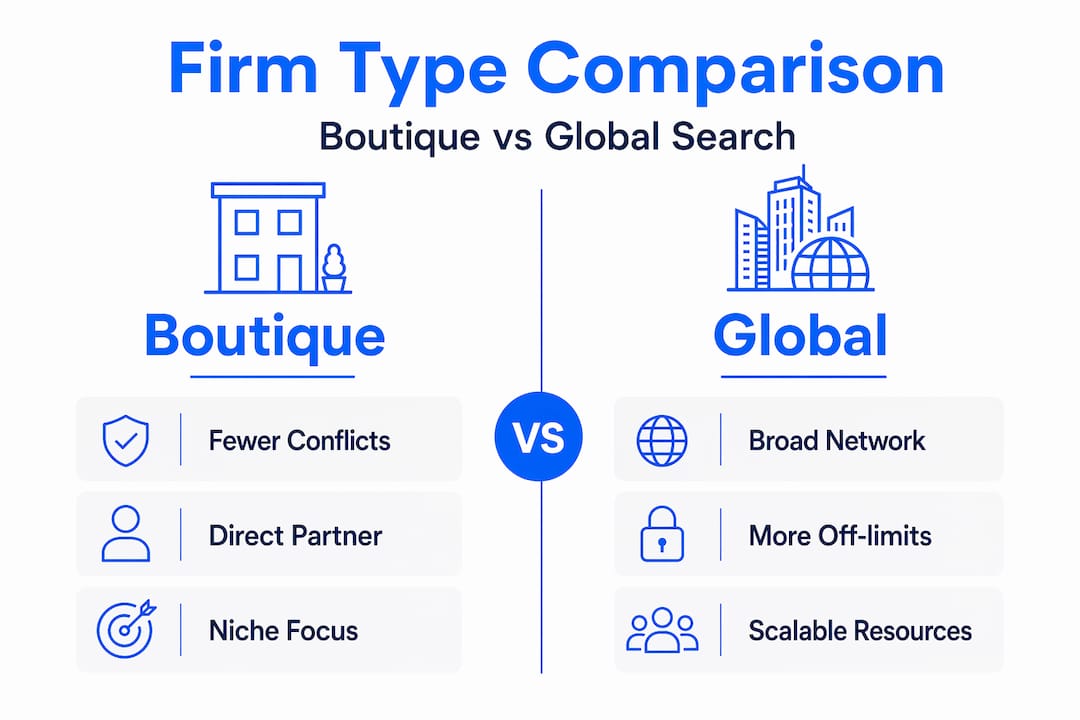
The boutique versus large global firm question deserves attention here. Large global firms often have thousands of off-limits conflicts that limit which candidates they can approach, because those candidates work for existing clients. Boutique firms carry fewer of those restrictions and tend to prioritize cultural alignment and direct partner accountability. Neither model is universally better, but understanding the structural difference shapes how you evaluate the firms you are considering.
Pro Tip: Before any evaluation meeting, send firms a one-page brief of your search. How they respond, what questions they ask, and how quickly they engage tells you more about their working style than any credentials document.
A step-by-step process for evaluating search firm candidates
Once you have your criteria defined, the actual evaluation process should follow a structured sequence. Here is how to run it.
-
Issue a focused brief, not a lengthy RFP. Long RFPs attract generic responses. A concise, specific brief attracts firms that actually understand your space and prompts sharper, more revealing replies.
-
Request a proof pack from finalist firms. Before signing anything, ask each firm for a 5-page proof pack that includes recent comparable placements, their search methodology, a sample market map, and evidence of how they access off-market talent. This single step filters out firms that cannot substantiate their claims.
-
Verify who runs your search. This is non-negotiable. Confirm directly that the senior partner presenting the proposal is the person who will execute the search day to day. Many large firms have senior partners who win business and then hand it to junior associates. That gap in seniority creates accountability problems and candidate engagement issues.
-
Review the proposed search plan. A credible firm will present a market map of the candidate universe, a clear sourcing strategy, a timeline, and a defined update cadence. Weekly progress reports should be standard, not optional.
-
Assess passive talent access. For specialized roles in manufacturing, engineering, and supply chain, the best candidates are rarely active job seekers. Ask firms to walk you through how they identify and engage passive candidates in your specific sector. Vague answers here are a red flag.
-
Evaluate candidate assessment frameworks. Cultural and leadership alignment beyond functional skills is critical to long-term success. Ask what structured assessment tools or interview frameworks the firm uses to evaluate candidates beyond their resume.
-
Verify confidentiality and conflict management. Ask specifically how they handle situations where a candidate is employed by one of their other clients. Get the answer in writing.
-
Discuss fees and commercial terms explicitly. Retained search fees typically run 20 to 30 percent of first-year compensation, paid in milestones at kickoff, shortlist, and offer stages. Any firm that is vague about fee structure at the proposal stage will be vague about everything else.
Use this quick pass/fail screening table to compare firms side by side:
| Evaluation criterion | Pass indicator | Fail indicator |
|---|---|---|
| Track record in sector | Comparable placements in last 24 months | Generic case studies, no sector specifics |
| Senior partner involvement | Named partner confirmed as day-to-day lead | Vague "team" references, no named contact |
| Passive talent access | Specific sourcing strategy described | "We have a large database" |
| Candidate assessment | Structured framework with cultural evaluation | Resume review only |
| Fee transparency | Milestone-based, clearly documented | Percentage quoted verbally, no written terms |
| Conflict of interest | Off-limits list disclosed upfront | Conflicts not addressed until asked |
Pro Tip: Ask each firm to name three companies in your sector they cannot approach due to off-limits agreements. Their answer reveals the real scope of their candidate access.
Common pitfalls when evaluating recruitment partners
Even experienced HR leaders make avoidable mistakes when selecting a search firm. Knowing where the process typically goes wrong saves you from repeating those errors.
The most damaging mistake is ignoring who actually runs the search. A senior partner's direct involvement throughout the engagement is what drives candidate quality and accountability. When that person hands off to a junior team member after the kickoff call, you lose the relationship, the judgment, and often the momentum.
Overvaluing brand name is a close second. The recognition that a large global firm carries does not automatically translate to better results for a specialized manufacturing or engineering search. Peer validation matters, as seen in rigorous rankings like the Forbes 2026 list of top executive recruiting firms, but brand alone is not a proxy for fit, accountability, or sector depth.
Other frequent errors include:
- Failing to check off-limits conflicts before engaging. A firm may be unable to approach your top five target candidates because those individuals work for existing clients.
- Not verifying retention data. Placement is not success. Ask for 12-month retention rates on comparable searches.
- Working with too many firms simultaneously. Retainer searches should be exclusive to one firm. Running parallel retained searches creates duplicate submissions, fee disputes, and candidate confusion.
- Overlooking contract terms. Replacement guarantees, fee refund conditions, and what constitutes a successful placement should all be defined before you sign.
"The firms that win your confidence in the pitch room are not always the ones that earn it in the search. Verify everything. Trust the process, not the presentation."
Verifying outcomes after the engagement starts
Selecting a firm is not the end of the evaluation process. The best practices for hiring firms extend into how you monitor and measure performance once the search is underway.
Agree on specific metrics before the search begins. At a minimum, define:
- Time to shortlist: How many weeks from kickoff to a qualified slate of three to five candidates?
- Candidate quality indicators: What does a strong candidate profile look like, and who approves it?
- Communication cadence: Weekly written updates should be standard, with a standing call every two weeks.
- 90-day and 12-month outcomes: What does success look like beyond the offer acceptance?
Once a placement is made, structured assessments and leadership interviews during onboarding help you catch misalignment early. A strong search partner stays engaged through the first 90 days, not just until the invoice clears.
Gather references from the firm's recent clients in your sector. Ask those references specifically about communication quality, how the firm handled setbacks, and whether the placed executive was still in role at the 12-month mark. Those three questions tell you more than any reference check template.

If the search stalls or the candidate quality falls short, address it directly with the named partner. A firm worth keeping will respond with a revised plan and accountability. One that deflects or blames market conditions without evidence is telling you something important about how they operate.
My take on choosing the right search partner
I have seen organizations spend weeks on elaborate RFP processes and still end up with the wrong firm. And I have seen others make the right call in two conversations. The difference is almost always whether they focused on the right things.
In my experience, the firms that consistently deliver in manufacturing, engineering, and supply chain searches are the ones where a senior partner is genuinely invested in the outcome. Not managing it. Invested in it. That distinction matters. When the person who mapped the candidate market is also the person calling those candidates, the quality of those conversations is fundamentally different.
What gets missed most often in formal evaluations is chemistry and candor. Can the partner tell you honestly when your compensation package is not competitive? Will they push back on a candidate brief that is unrealistic? The transparency that separates top search partners from average ones shows up in those moments, not in polished presentations.
Boutique firms in specialized sectors also tend to have more direct partner accountability and fewer structural barriers to reaching the candidates you actually want. That is not a universal rule, but it is a pattern worth taking seriously when you are hiring for a niche leadership role.
The RFP will not tell you who to trust. The proof pack, the direct conversation, and the willingness to be honest when it is uncomfortable will.
— Frank
How Teamprovide helps you secure specialized leadership talent
When you have done the work to evaluate your options carefully, you want a partner who meets every criterion you have set.

Teamprovide specializes in executive recruitment for manufacturing, engineering, and supply chain sectors, with over 500 successful placements and a 95% client satisfaction rate. Every search is led by a senior partner from brief to offer, with full transparency on methodology, candidate sourcing, and commercial terms. Teamprovide's approach to passive talent access and cultural fit assessment is built specifically for the complexity of specialized industrial leadership roles. If you are ready to move from evaluation to execution, explore Teamprovide's recruitment solutions to see how a purpose-built search partner can reduce your time to hire and improve the quality of every shortlist you receive.
FAQ
What criteria matter most when evaluating search firm partners?
The most critical criteria are senior partner involvement, proof of sector-specific track record, access to passive talent, a structured candidate assessment process, and full transparency on fees and conflicts of interest.
How do boutique firms differ from large global search firms?
Boutique firms typically have fewer off-limits conflicts, more direct senior partner ownership throughout the search, and a stronger focus on cultural alignment compared to large global firms, which offer broader reach but more structural limitations.
What is a proof pack and why should I request one?
A proof pack is a 5-page document from the search firm covering recent comparable placements, their sourcing methodology, a sample market map, and evidence of passive talent access. It is the fastest way to validate whether a firm can substantiate its claims before you commit.
Should I use multiple search firms for the same role?
For retained searches, no. Exclusive retained engagements reduce the risk of duplicate candidate submissions, fee disputes, and conflicting ownership claims, all of which are especially problematic in confidential senior-level searches.
How do I measure a search firm's performance after placement?
Track time to shortlist, candidate quality against the agreed brief, and most importantly, 12-month retention of the placed executive. A strong search partner stays engaged through the first 90 days and welcomes those performance conversations.